Cantos Ancestrales
Barcelona 16-19 July, 2018
Bookings through Alas
Cantos Ancestrales
Barcelona 16-19 July, 2018
Bookings through Alas


A great article about universal singing.
Singing is for everyone!
https://theconversation.com/stop-obsessing-over-talent-everyone-can-sing-74047

Once in a SAT retreat, Claudio Naranjo said that music had been for him a kind of mirror, especially in his childhood. It mirrored back to him a range of emotions and sensitivities that he rarely saw reflected in everyday life.
This rang bells for me. In all my years of musical life, it had never occurred to me that music was a mirror. As I considered this, I realised it was so, for me also. And this deepened my understanding of the role music had played in my life. Music, for me at least, is far, far more than “entertainment”.
In an emotionally stunted environment, and in a culture that ridiculed softer sentiments, I was starving for affirmation of my emotional life. For me childhood was a battleground where it was better to give away as little as possible. My inner world became intensely private. I didn’t want others trampling what was precious to me. As something of a misfit, I didn’t readily find companions with whom I could share my complex inner world. Adolescence magnified these difficulties, and I turned to other things to find satisfaction.
One of them was music. I already played clarinet to a high level by then, and teachers were surprised at the emotional maturity of my playing. I could bring people to the brink of tears. Having music in my life was a life-saver. My soul had an oxygen line to the surface. Finally I could breathe. With music I could express what I felt, without the encumbrance of words, without being torn apart on the war-fields of adolescence.
I also spent hours in my room listening to classical music. Here, the world opened up to me. Music showed me tenderness, joy, passion, frivolity, grief, war and peace, the sacred and the profane. It showed me expansion when mostly I felt contracted. It gave me the taste of sweetness when much of my life was bitter. I knew ecstasy in the depth of my bones. This was my education of life, my learning about people. It didn’t exactly prepare me for social interaction, and I remained socially under- developed well into my late 20s. But with music, I could dive deeply into my own soul. And somehow, this kept me connected to the human world. If humans created this music, then they too, must be souls crying out in the night.
An artist friend once said to me, that music had kept me open, some part of me at least. I thought a lot about what he said. I think what he sensed was this oxygen line from my soul to the surface of life. Yes, in this way, music saved my life. I try to imagine my life without swimming in the sea of music. But I cannot.


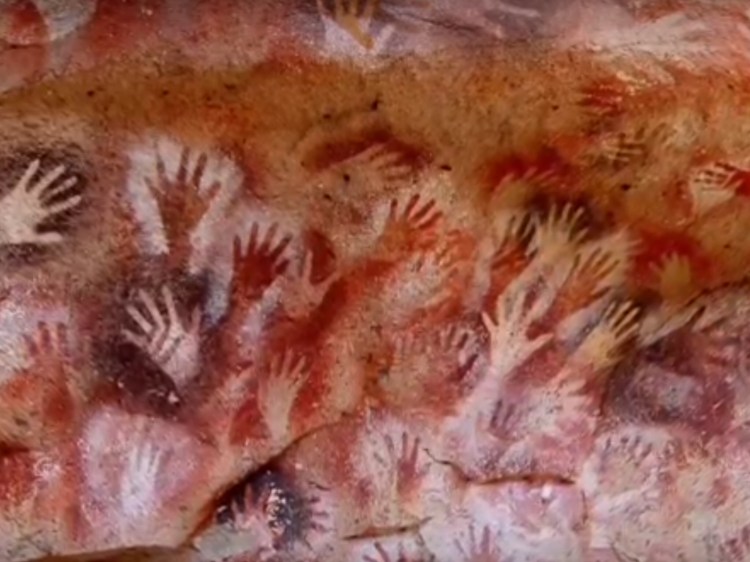
I was deeply moved by Werner Herzog’s documentary, “Cave of Forgotten Dreams”, about the Chauvet cave paintings in southern France. Far older than the famous paintings of Lascaux, they display passion, reverence, and delight in the beauty of the animals they represent.
What is this drive to paint an image of the animals that share our world, in a sometimes high and dangerous place to reach? Why would the Palaeolithic people risk such heights? What moved them to express their vision of the world, and their place in it? Whatever the answer to these questions, It is apparent that this drive to create is something innately human. Many thousands of years later, we are still at it.
Despite the beautiful paintings, it was another section of the film that stayed with me most vividly. The ancient cave dwellers of Germany were not so prolific in their paintings (not that we have yet discovered), but they were makers of flutes. Who knows what other musical instruments they also had, that have not survived. The bone flutes remain, and one was carbon dated to 42-43000 years old, making it the oldest surviving musical instrument in the world. The flute was sufficiently intact for an assessment of its finger holes, and thus its tuning. This was exciting! We can see ancient cave paintings today, but what do we know about ancient music? The flute was tuned to….drum roll….the pentatonic scale, equivalent to the black notes on a piano.
It is perhaps no surprise. Music, at least on our planet and in our dimension, has it’s foundation in laws: laws of physics, laws of nature, laws of the universe. These sound waves and frequencies together produce harmonious and “pleasing” harmonies, and these, do not. The more dissonant intervals, such as augmented 4ths and major 7ths, are not invalid: they are spicy and delicious, like curry, or perhaps something sour like lime. But like all condiments, you can’t live on a diet of them. The foundational staples of music, the octave and the perfect 5th, are like the main course foods: they create a sense of resolution, of homecoming, of closure. They are warming and nutritious. They may also be the stable platform from which spicy dissonance may emerge, and then resolve and return.
Palaeolithic cave dwellers did not measure frequencies on sound wave machines, nor did they go to Conservatoriums. What is harmonious is obvious, at least, when you learn to listen. They made their little bone flutes to resonate with the tuning of the universe.
It is ironic, that in an age of easily available recorded music, many people have lost touch with music as a living, breathing part of everyday life. Now we have whatever music we choose at the touch of a button – symphony orchestras, pop and rock stars in our own living room, strange and exotic music from around the planet. The finest singers, virtuosi of all kinds, rock legends of the past – we can have whatever we want, whenever we want it.
Yet this professionalisation of music has detracted from, and perhaps proved intimidating to, the everyday music of life. Where once people sang together, for group togetherness, for work, for joy, for sorrow, we now stick on a CD or MP3. This instant gratification betrays the hard work behind the talent – like any craft or art, mastery takes years. This should be applauded, but it should not deter the more amateur music makers from sharing the sound waves.
There is a wonderful movement toward choir revivals in many places, as well as amateur musical get-togethers, such as folk clubs, open mike nights, city bands, community orchestras and the like. Music needs to be reclaimed as a human activity, for ALL humans, not just those who spend years in exclusive training. Without wanting to sound overly political, it needs to be democratised! It is as human as making a fire, cooking food, playing with children, making love, and having a family gathering.
I don’t wish any apocalyptic regression on us, but sometimes I imagine a world where there is no power for our electronic music-playing machines. Imagine! A world without music! Then the musician in us all would come out of the woodwork, and we would make our own living music again! The local fiddler or pianist or singer/songwriter would once again be a valued member of each town. Instead of being compared to the latest, or classic, recordings, and found sorely wanting, perhaps they could be appreciated for what they do bring to the community.

 The Song of the Ancients