WinterSong!

The Three Brained Being
 The Greek – Armenian mystic Gurdjieff saw the human being as a three brained being: A head brain, or intellect; a heart brain, what we might today call emotional intelligence; and a gut or instinctive brain, which could be our “animal” intelligence, as well as kinesetic intelligence. We are far more than a mind/brain.
Neurones of the Central Nervous System (CNS) are found not only in the brain, but also in the heart and the gut. There is intelligence in all the organs of the body. (See article below) There are different kinds of intelligence. Healing and wholeness come not just from cognitive understanding. Any system of human understanding, any therapy or school of healing worth its name, must address our experience in all its dimensions or aspects. Alas, “Scientism”, (in contrast to science), has reduced the human experience to that which can be measured on a machine.
Modern education largely focuses on the rational intellect. There is some attention given to sport, usually with a competitive focus. And the arts are still hanging in there by the skin of their teeth, despite frequent downgrading and budget cuts.
We need to encourage more wholistic approaches to education, therapies, and our general concept of what a human being actually is. In the case of healing and general well-being (seemingly rare in these times), working with voice and movement, for example, can be combined with both nurturing emotional support, and with cognitive and rational understanding. Philosophers and poets from ancient times have espoused the benefit of movement, for example, as a way of digesting intense mental learning. We need a three pronged approach.
We are not just a brain in a jar!
We are body: tissues, bones, organs, blood, neurochemicals, instinct, movement, pleasure.
We are heart: we are the longing and wounded child buried away, we are kindness, we are delight, we are grief for the earth and the ones who have passed, we are touched and moved to tears by a painting or a song.
And we are mind: rational and reasonable, weighing up the evidence, gathering information, comparing, categorising, imagining, remembering.
The head centre is an important part of our being, but the neglect of the other centres has led to a great imbalance that shows up in almost every area of modern life. Impoverishment of, and even disconnection from, the heart and gut are part of a vicious cycle of blocked and rigid emotions, repression, distrust of our innate intuition and embodied wisdom. Lopsided development leads to alienation from self, others, and the earth. Disregard for the heart and gut by our political, economic, and social systems enables the trampling of such qualities as flexibility and kindness, and the desecration and commoditisation of the arts and cultural life. Now it’s all about competition, economic rationalism, and the cult of the hero. It’s survival of the fittest. Only the hero takes home the prize. No room for second place.
It’s hardly conducive to healthy community is it? Where’s the tribal spirit of interdependence and cooperation? In reality we are no different genetically from our caveman ancestors, who were social beings and lived in interdependent tribal groups. Homo sapiens – the man who knows. But knows what? We have indeed eaten from the Tree of knowledge of good and evil, and we have been paying for it ever since.
Hard headedness has led to hard heartedness. The soft underbelly of our animal self has been attacked and it’s deep wisdom rejected. It has had no choice but to armour itself against the tides of so called human progress. It hides underground, along with all our other “non-desirables”, waiting for an opportunity to be heard, and in the meantime, wreaking havoc with our sense of well-being. We need to bring back balance to our understanding of ourselves. Scientism has reduced us to little more than robots: hormonally automated bags of guts, blood and bones.
An education, a consciousness, a life, that seeks to bring balance to the three centres of intelligence can only make us more complete, more whole, more fully who we are as human beings. Life is vast and deep. Our mental/rational self is only one thread of this great tapestry. Who can understand the fullness of this mystery?
https://hubpages.com/education/your-second-brain-is-in-your-heart
Neanderthal Art
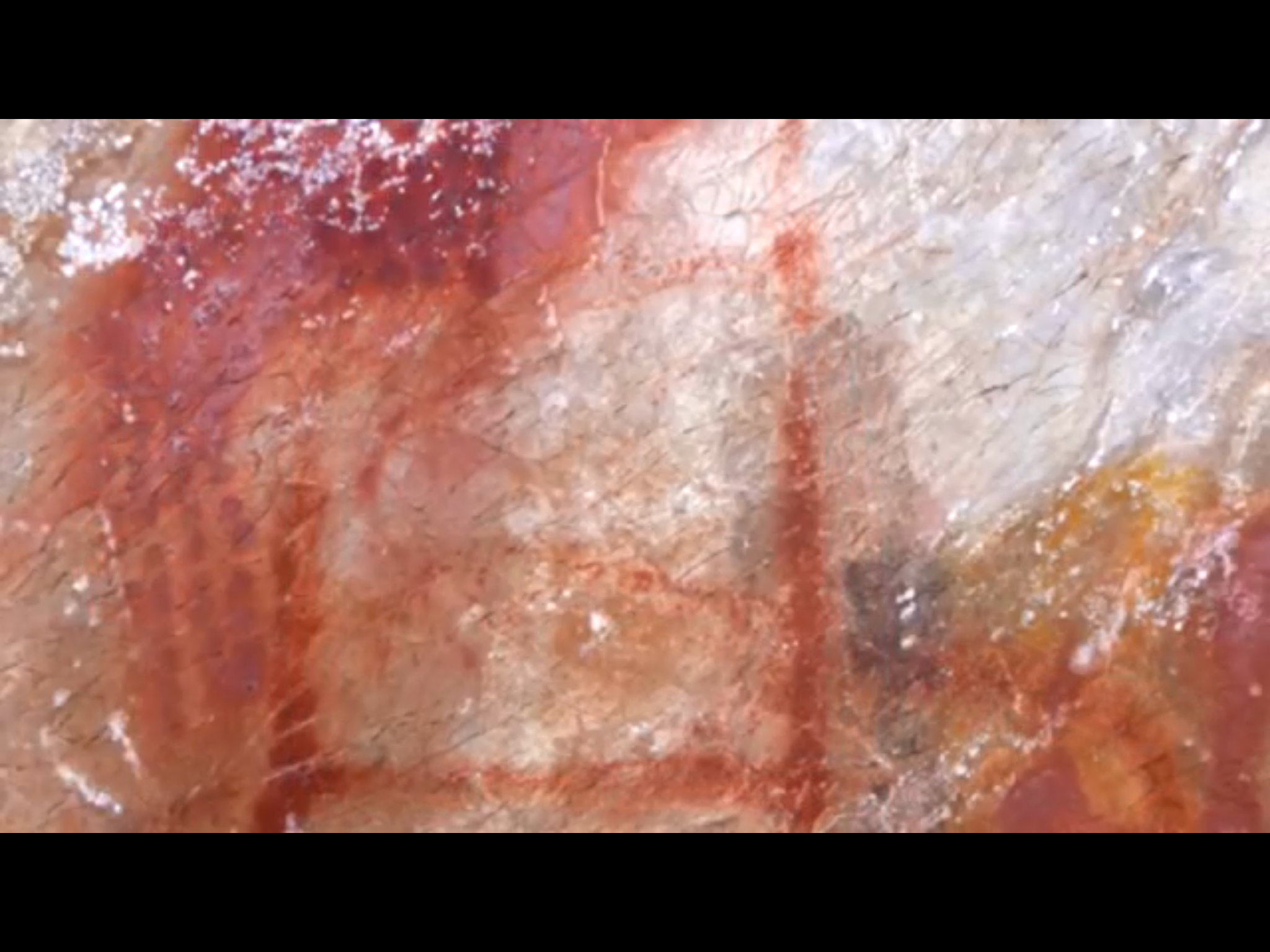
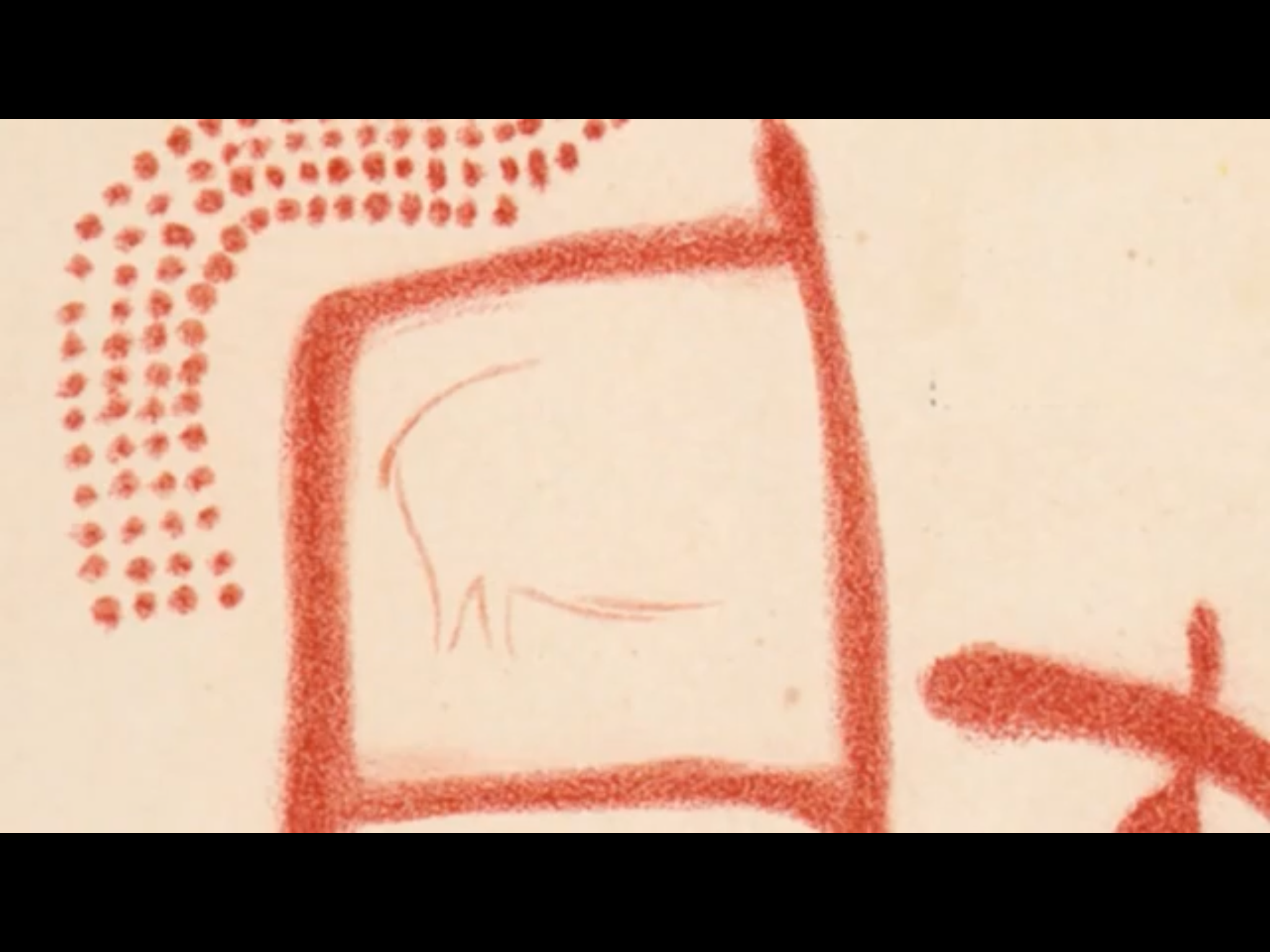
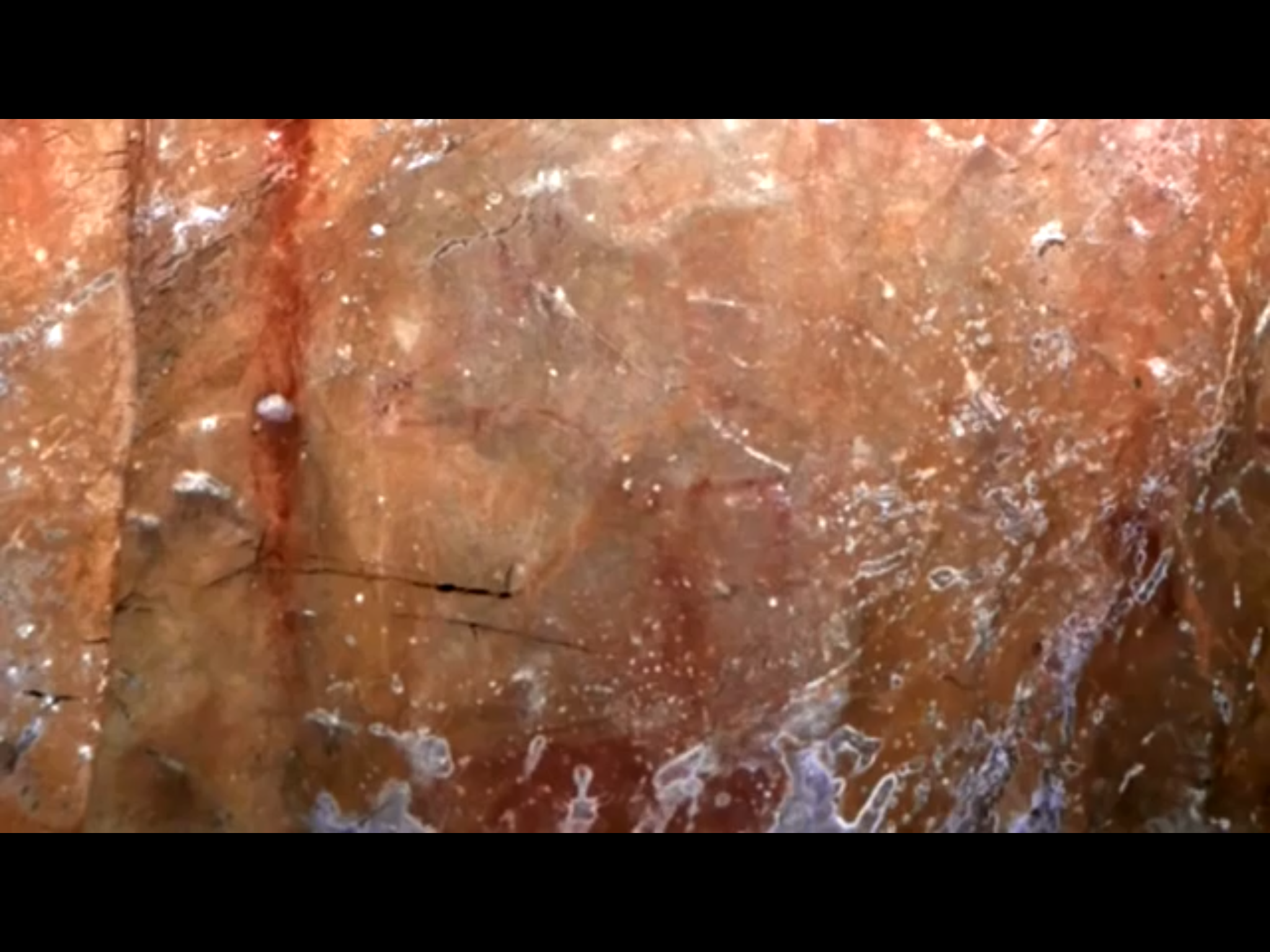
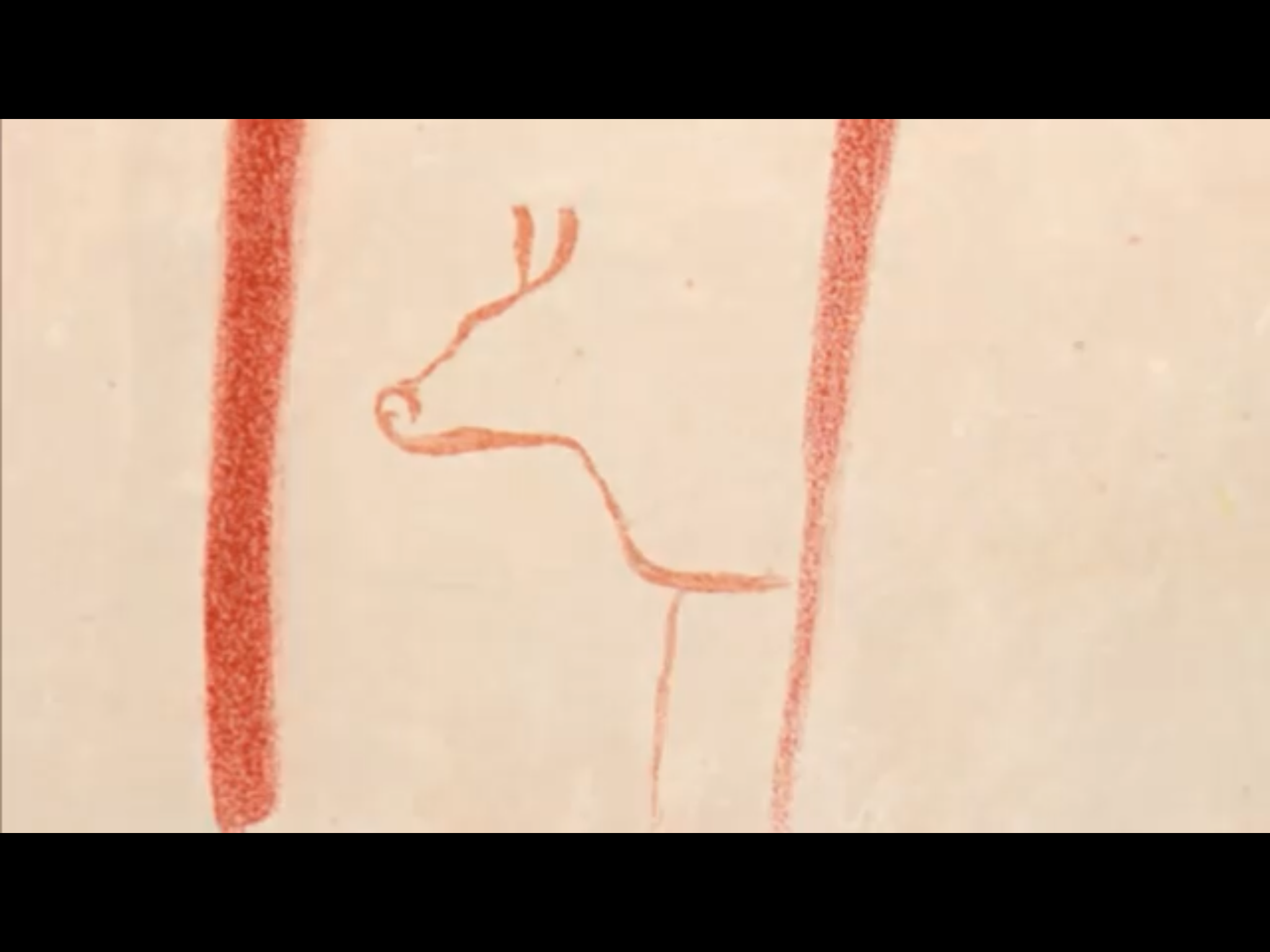
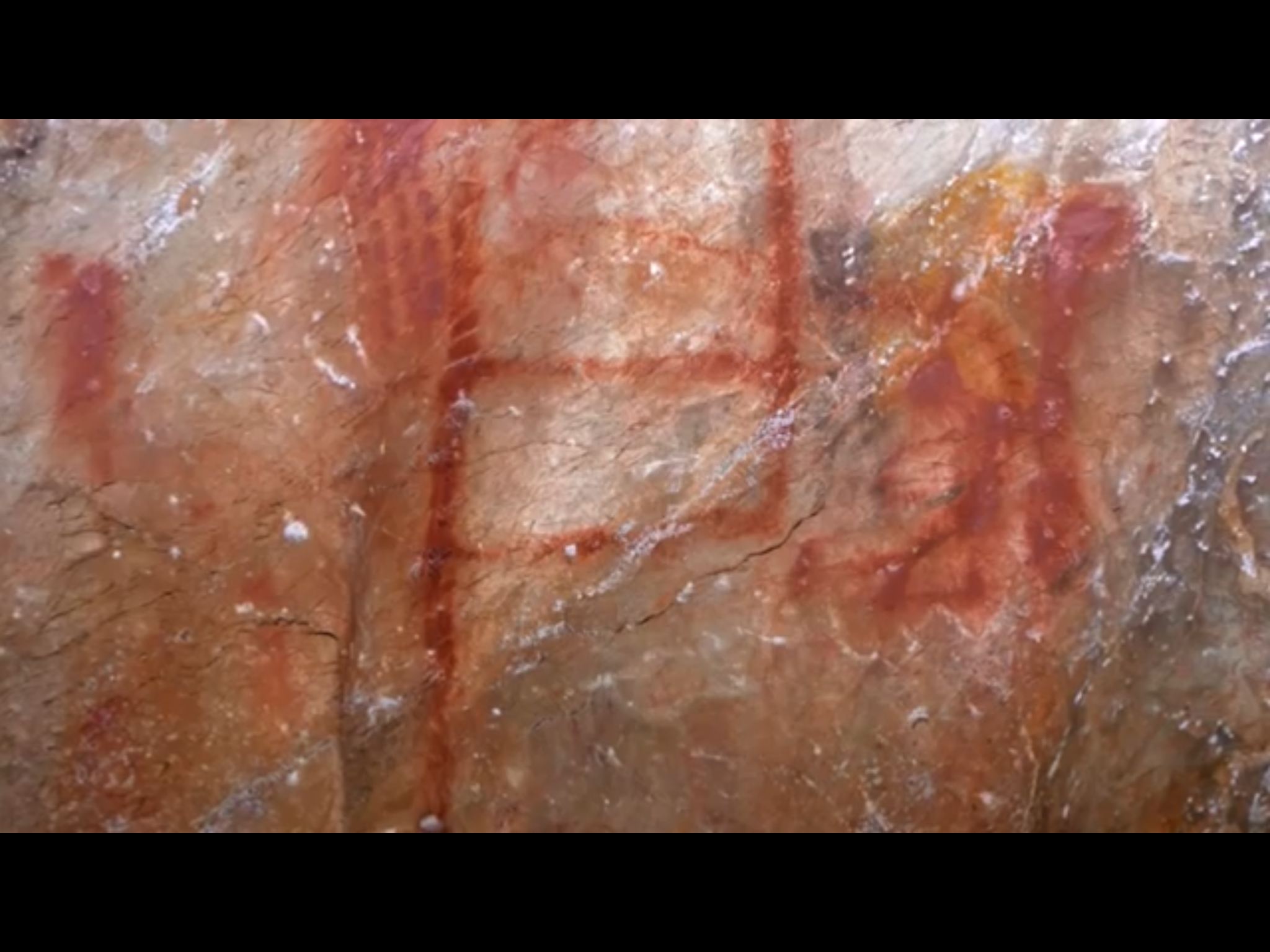
These cave paintings in Cantabria, Spain, have been dated by Calcium Carbonate techniques to be more than 65000 years old. This predates the arrival of Homo sapiens in Europe by some 20-25000 years. Scientists thus believe these paintings are rare surviving examples of Neanderthal art.
19th century impressions of Neanderthals were of the “Homo Stupidus” variety, and some of these attitudes prevail today. However, examples of art, such as painting and the existence of flute fragments, suggest that they were not as primitive as once believed.
Although a far cry from the masterpieces of the AltaMira, Chauvet, and Lascaux caves, for example, the pictures below demonstrate a symbolic and conceptual view of the world.
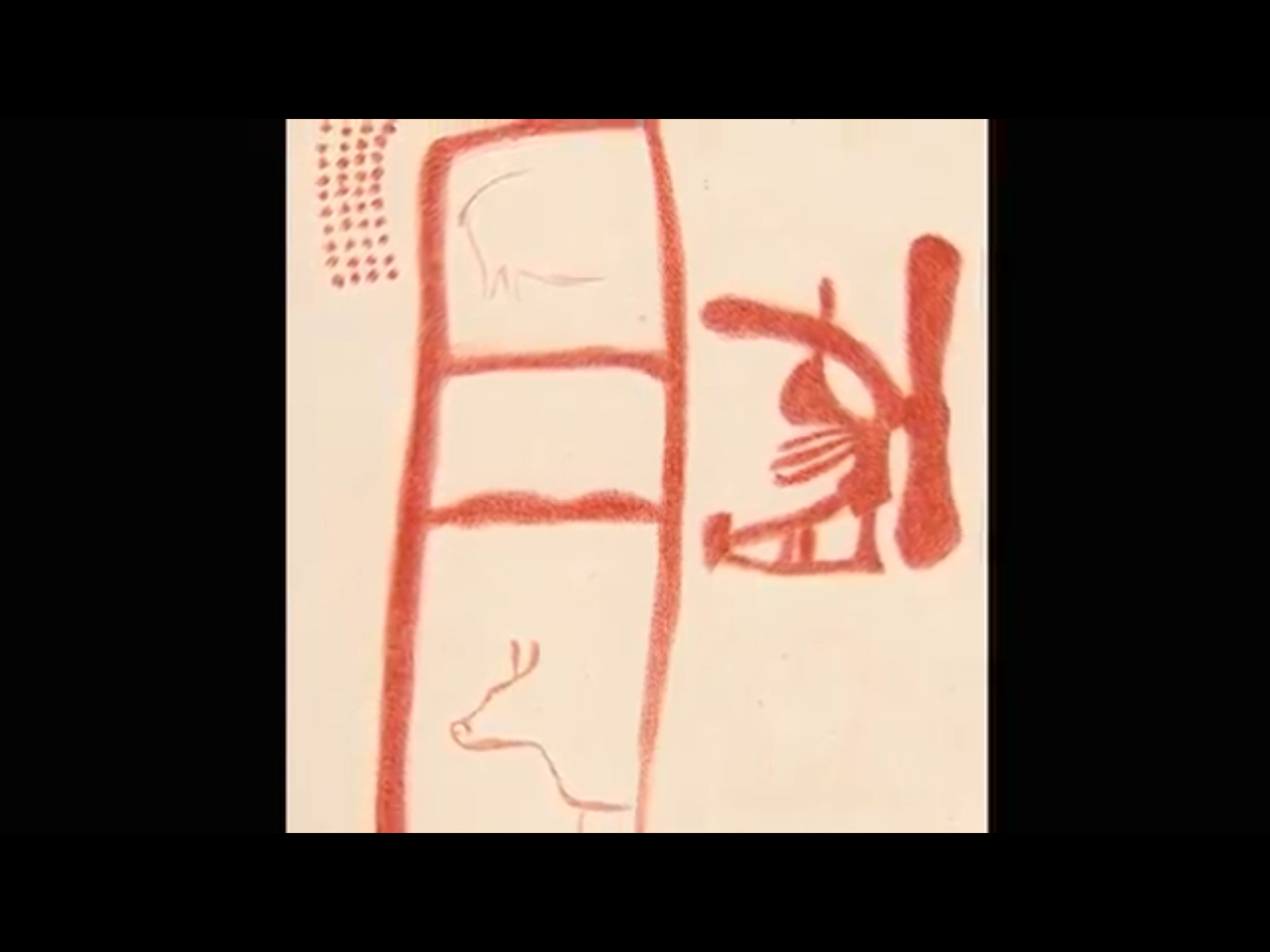
Music, on the other hand, is a mostly non-representational, and therefore abstract art. We can say that music is composed of patterns, and that animals too make patterns, like a spiders web, or a blackbird’s repertoire of songs. But animals are generally unable to deviate from those instinctual patterns. Artistic freedom and intentionality seems to have awakened in human species with the Neanderthals. They were the first known humans to deliberately bury their dead, and decorated graves with offerings. Before this time, the boundary between human and animal becomes blurry.
There are some linguistic and physiological theories that Neanderthals had singing before they had language. These activities fire up different parts of the brain, as has been demonstrated in stroke victims who can sing but not speak. It would make sense for singing to come before language, as song appeared first in nature, and as babies babble before they can speak.
There are also remnants of bone flutes believed to be Neanderthal. Discovered at Divje Babe in Slovenia, the fragment is made from the femur of a cave bear. Carbon dating suggests a date of 60000 years ago, putting the flute in a period when Homo sapiens had not yet arrived in Europe. As they are only fragments it isn’t possible to discern the tonality, but the finger holes remaining suggest a diatonic minor scale.
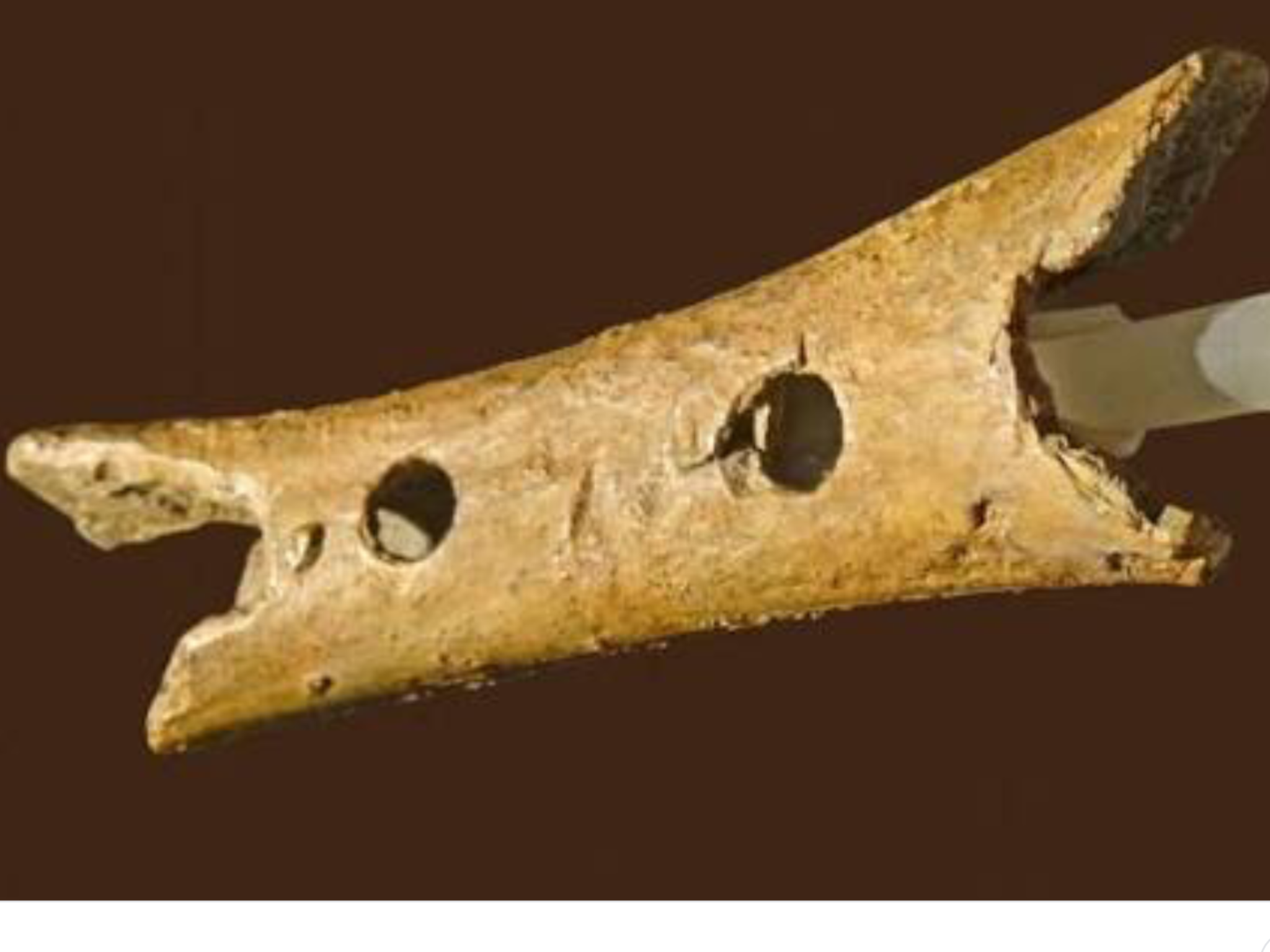
What was this flourishing of artistic intention that seemed to begin with the Neanderthals, and continues unabated today? What is the point of art, the purpose? Was it evolutionarily advantageous? Could a fine singer or painter or flute player court a potential mate more successfully? This behaviour is clearly at work in the bird world. Is art merely an aphrodisiac?
Or is this another patriarchal interpretation of something that is, ultimately, a mystery?
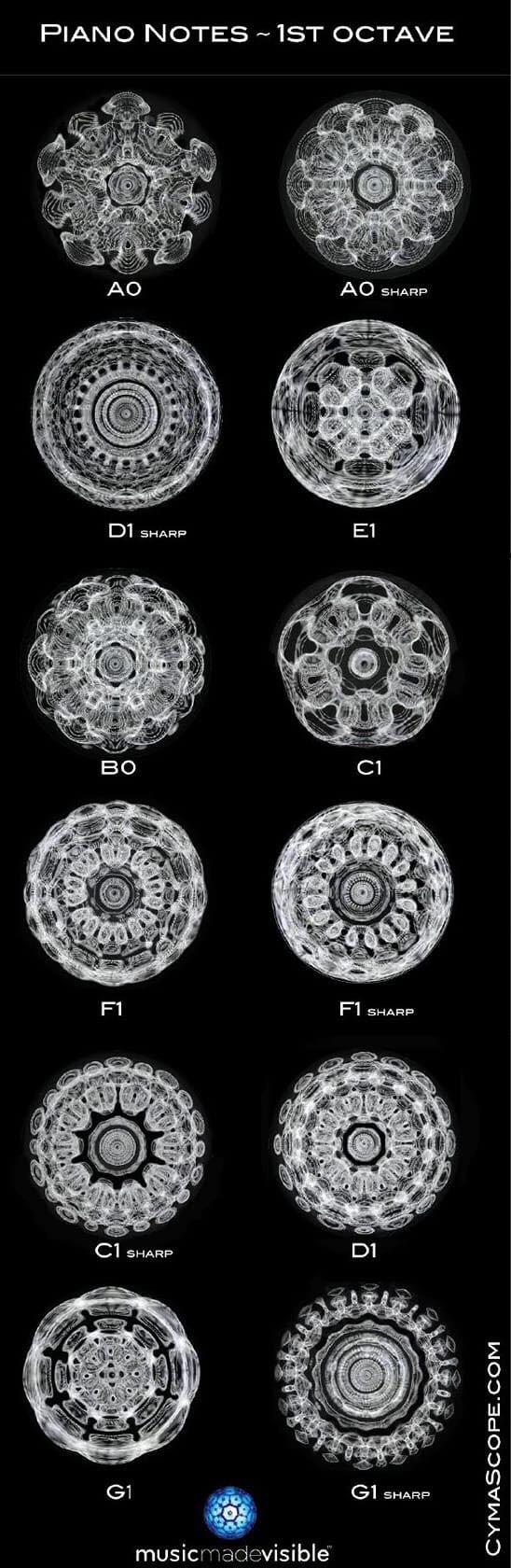
Creation with Vibration
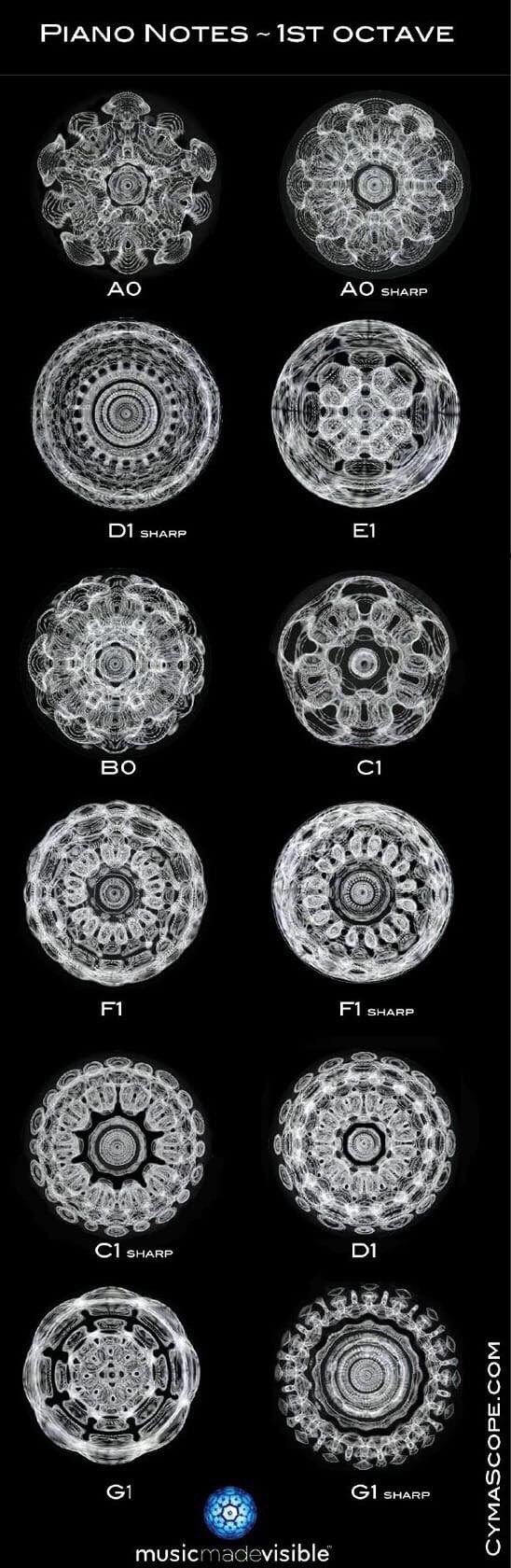
In the beginning was the word….
Vibration Pattern of Musical Notes in a Bowl of Water
Upcoming workshop
Announcing an intensive in Hobart, Tasmania.
The Song of the Ancients: Conscious Voice and Movement
November 8, 9, 10
Bookings through Kickstart Arts
https://www.kickstartarts.org/song-of-the-ancients
Voice Yoga 1 – Why work with the voice?

At one of my workshops, a participant, an avid yoga practioner, commented that this was like yoga for the voice.
I thought that was an insightful comparison.
Stretching, strengthening, and loosening; aligning the breath so the voice is integrated with the body; locating the voice in the body, rather than in the head; developing fine sensitivity, balance, and body awareness: these could all be considered aspects of voice yoga.The voice, like the body, is a direct expression of our being. It is our way of moving through the world, expressing ourselves in the world. Through movement and voice, we ARE in the world, meeting others, negotiating all the experiences that make up a life.
The experienced ear, and eye, can “read” a great deal about a person. The experiences of childhood, for example, remain in the body, and thus also in the voice. Traumas, fears, obsessions and compulsions (over-control), lack of confidence, depression, can manifest in, for example, vocal tightness, restriction of range, color, volume, speaking far back in the throat as if to “swallow” ones own words, a dead and monotone voice with no vibrancy, a thin and dry voice unconnected to the breath and body. Many people are too tight and controlled in the throat, whether speaking or singing, and are cut off from the powerful sense of support and aliveness that comes with good breath connection. Others sound as if they could blow away in the wind, without a trace.
The state of the voice is an expression of the soul, the body, and the mind. Our lives can be heard in our voice as symptoms, such as those mentioned above – tightness etc. In working with these symptoms, we gently stretch and ease and create space for new sounds to occur. By opening up the voice, the student may experience some of the original fears, or other psychological disturbances, that closed down the voice and breath in the first place. This is normal and to be expected. Likewise, when holding a yoga pose, the student may encounter the arising of long buried thoughts and feelings.
It’s it important to approach this work with respect and gentleness, and not to push yourself too far. The throat area is extremely sensitive and triggers many primal instincts. Breathing and suffocating, ingesting and vomiting, fear, disgust, and choking are all felt in the throat. Have a friendly and kind attitude toward your experiences.
I commented in a previous post about studying voice in my difficult early 20s. I only felt like singing when I was happy, and often that’s still the case! However, I discovered that singing, with my body and breath open and in alignment, would CREATE happiness! It was the kind of exhilarating happiness that seems to have no logical reason, like after jumping into a cold river! I discovered then that happiness flows both ways!
In the same way, a person with a thin, weak and breathy voice may discover powerful, rich and earthy sounds they have never made before. They may hardly believe their own ears! This is archetypal work. The self-concept changes and expands with the realization of what qualities have been buried and hidden away from the world, dormant and underdeveloped.
The voice is like a direct hotline to our soul. This is what makes it potentially profoundly moving, and sometimes a terrifying thing. When we sing, especially in front of others, we may feel naked: our everyday mask begins to slip and we have nowhere to hide. If we can dive into this experience and let others see us, in all our shakiness, timidity and lack of control, some taste of essence can begin to shine. We see each other in and through our humanness, rather than the thick plastic mask of “image”, “who I think I am”, or “what I want you to see”.
In loosening what has been restricted or dulled, in aligning what has been unconnected, we begin to allow new ways of being in the world.
New Workshop in Val d’Aran: voice, yoga, and the great outdoors.
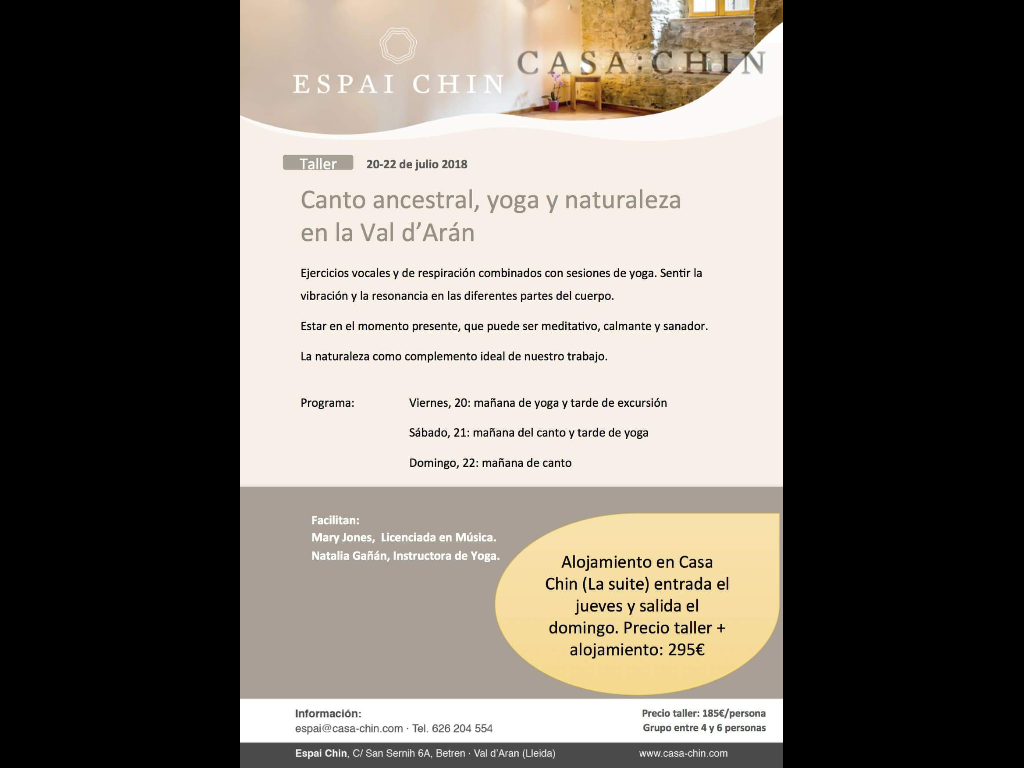
Combined with yoga instruction and guided excursions in the great outdoors of glorious Val d’Aran, this is a small group retreat for joy and rejuvenation.
Accommodation is available in the beautifully restored Casa Chin.
Small group means more individualized attention.
Treat yourself to this restorative weekend.
Spanish/English with translation.
 The Song of the Ancients